
Guatiza and the Cactus Garden: The Green Jewel of Lanzarote
People drive past Guatiza with the windows up, on their way to the caves or the north coast, and almost nobody stops. Their loss. In this quiet village of white houses and prickly pear fields, César Manrique built the last great work of his life: the Jardín de Cactus, a hillside of spines and shapes rising out of an old quarry. Give this corner of the north-east a slow half day and it will stay with you far longer than any postcard.
⚡ Quick summary before you plan your days in Lanzarote
- What to know firstPeople drive past Guatiza with the windows up, on their way to the caves or the north coast, and almost nobody stops.
- Who it is forFor most of the twentieth century this hole in the ground was a rofera, a quarry where farmers dug picón, the black volcanic ash they scatter over the fields to keep the moisture in.
- Main optionsA Quarry Turned Into a Garden · Walking the Cactus Garden · Guatiza and the Cochineal Fields · Planning Your Day in the North-East
- Duration, prices and detailsWhere exactly is the Cactus Garden in Lanzarote? The Jardín de Cactus is in Guatiza, a small village in the municipality of Teguise in the north-east of Lanzarote, on the LZ-1 road between Arrecife and Haría. It sits among the prickly pear…
- How to bookBook on WhatsApp · +34 603 27 93 06


📷 Gallery
🧭 Zack's 3-click Lanzarote experience planner
💬 Send my plan to Zack on WhatsApp
Because a tour should feel like travelling with a friend: Zack designs the route around your rhythm, your curiosity and your camera roll — and changes it whenever you wish.
A Quarry Turned Into a Garden
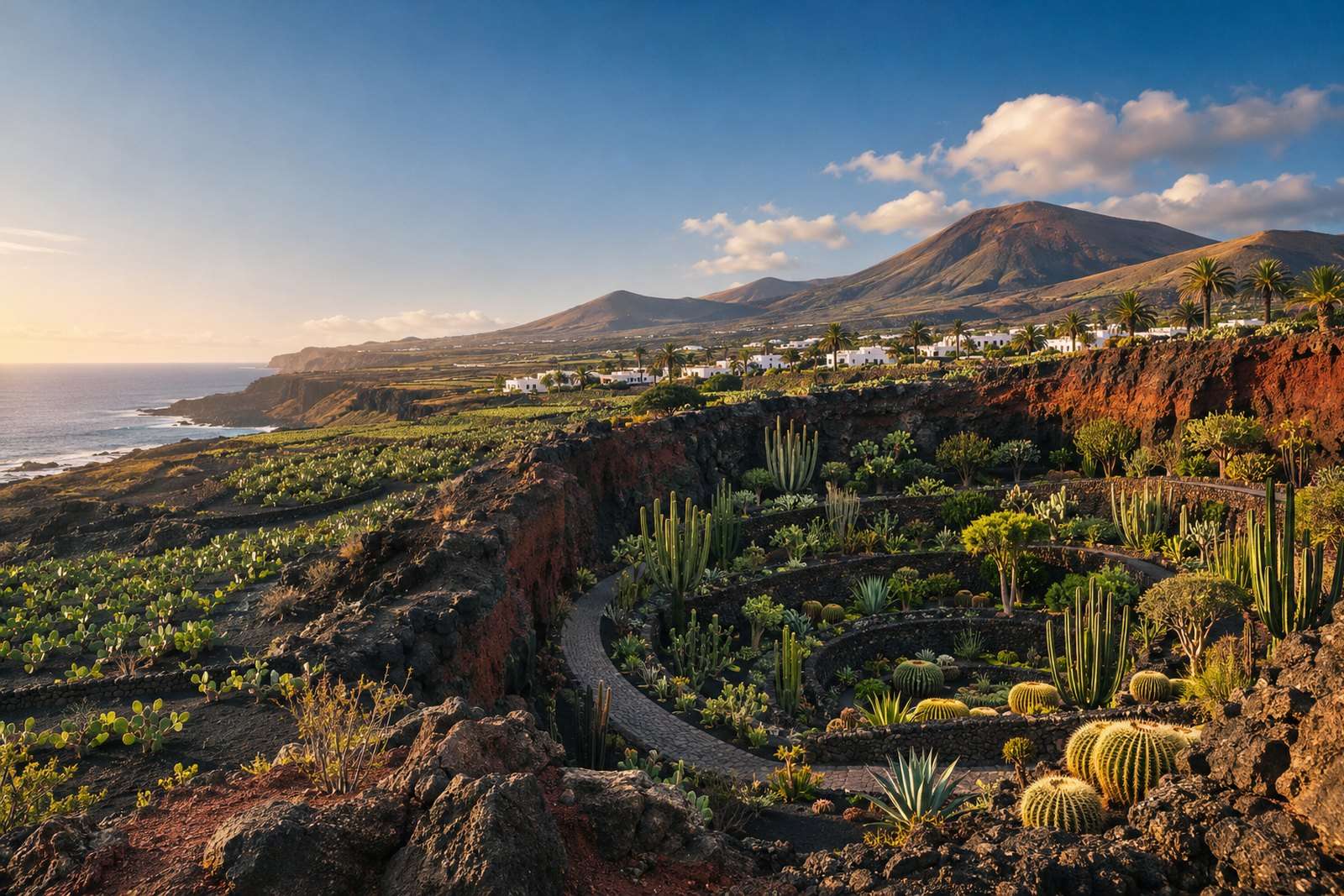
For most of the twentieth century this hole in the ground was a rofera, a quarry where farmers dug picón, the black volcanic ash they scatter over the fields to keep the moisture in. When the good material ran out, the pit became the village rubbish tip: exactly the kind of scar nobody wants on a postcard. César Manrique looked at it and saw a garden. The idea was already brewing in the sixties, the old windmill on the rim was restored in 1973, and after years of delays the work sped up at the end of the eighties. The Cabildo opened the Jardín de Cactus on the seventeenth of March 1990.
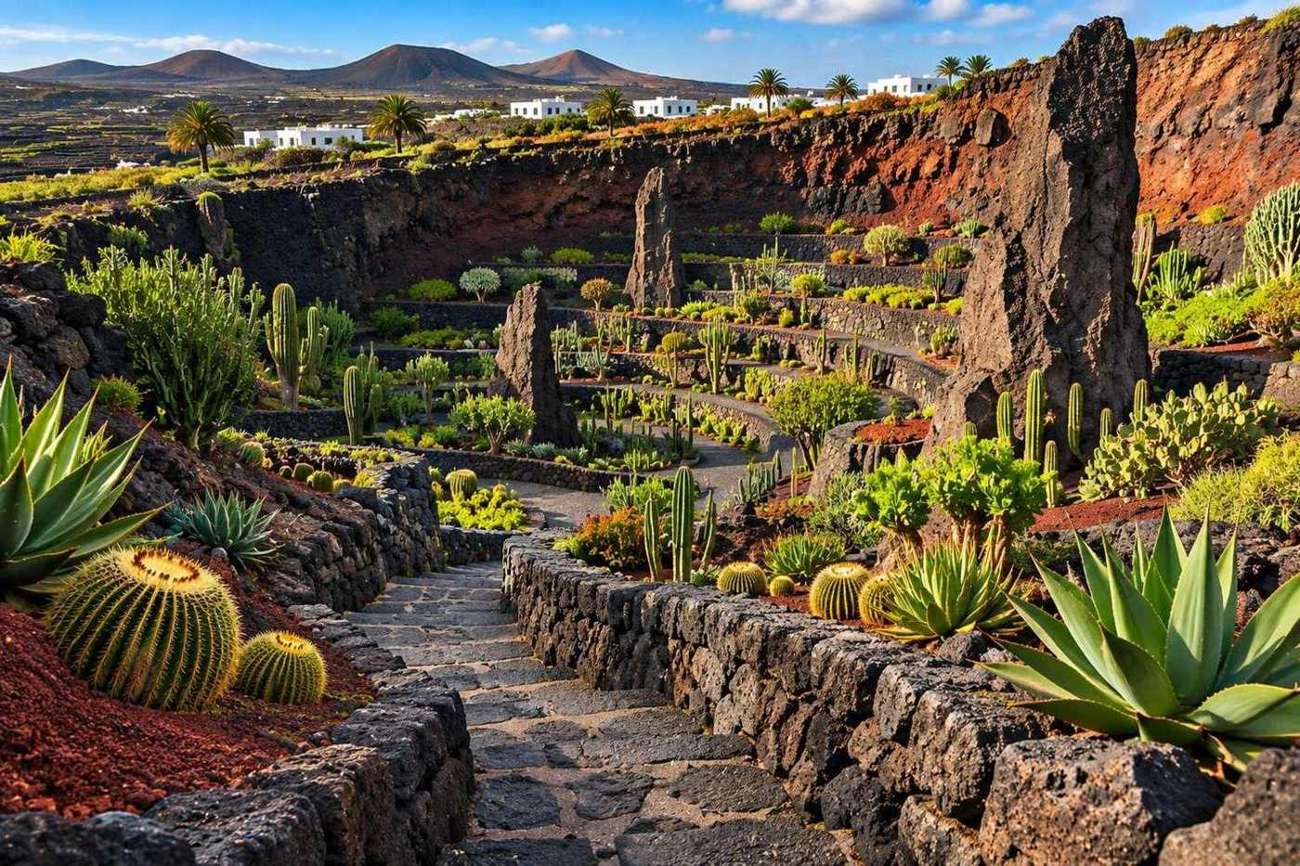
It was the last thing Manrique built on the island he spent his life defending, and in some ways the most him. Instead of filling the quarry in, he kept every cut the diggers had left: the terraces follow the shape of the excavation like the bancales of local agriculture, paths and walls of volcanic stone step down into the bowl, and the big basalt monoliths the quarrying left behind stand where they fell, turned into sculptures. The colours alone are worth the drive: red, black and brown stone under a green riot of cacti. If you are touring with car hire in Lanzarote, this is an easy stop on the road north.
From rubbish tip to total art
Manrique liked to call his approach arte total: architecture, sculpture and gardening fused into one thing that could not exist anywhere else. The entrance sets the tone, with a huge metal cactus bristling with thorns on the roadside and an iron gate full of plant shapes. Then the access corridor does something clever: it hides the view until the last second, so you turn a corner and the whole garden opens below you like an ancient theatre. In 2017 the garden received the International Carlo Scarpa Prize for the way it protects the land and the local culture, and the whole site is now an Asset of Cultural Interest. Fancy words, but stand on the rim at ten in the morning and you will get it without any of them.
The windmill on the rim
On the highest point of the garden stands a restored maize mill, one of the last traditional windmills left on Lanzarote. It was rebuilt back in 1973, years before the garden itself existed, and inside you can see how grain was ground into gofio here through the nineteenth century. Climb up for the view over the bowl of cacti, the village and the endless patchwork of prickly pear fields, then take the spiral staircase by the shop, wrapped around a hanging sculpture made of old fishing buoys. On a clear day the eye travels from the green of the valley to the lava of the coast in one sweep, and you understand why Manrique kept coming back to this exact spot. Small details, big grin. That was always the point.
Walking the Cactus Garden
The collection holds more than 4,500 specimens and nearly 500 species brought from five continents, and what makes it work is that nobody arranged it like a science textbook. The plants are grouped by shape, so columns stand next to barrels, barrels next to pads, and the tall Mexican giants march along the top terraces while low mats of spines creep along the paths. You walk down into the bowl and back out again in about an hour, and the whole garden is visible from the rim, so there is no route to get wrong. Photographers should bring a wide lens and patience.
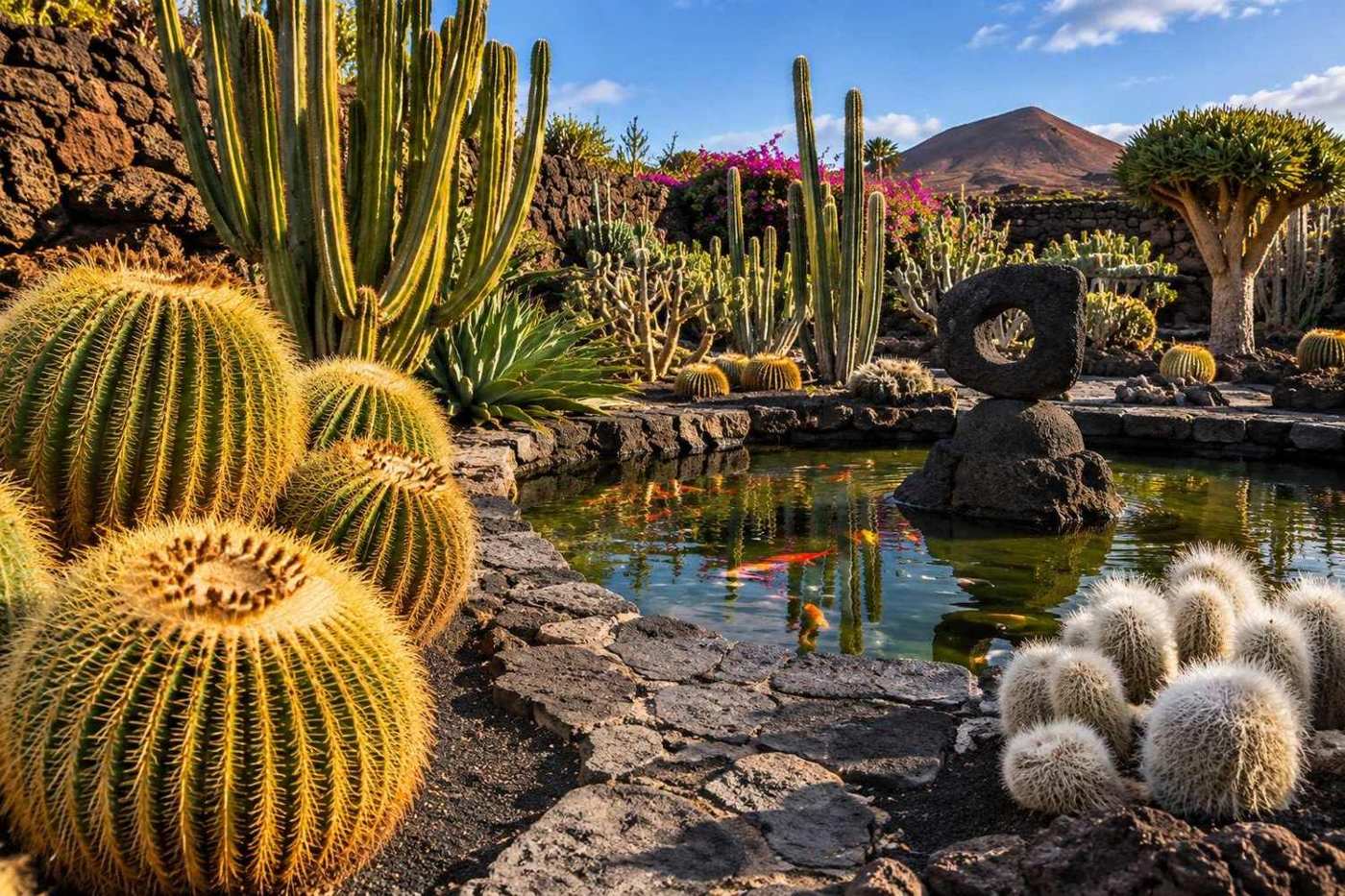
Water is the quiet star here. In a landscape built from fire and dust, Manrique dropped a pond with bright orange fish and a stone sculpture into the middle of the terraces, and the reflection of the cacti does something magical to the light. Around twenty specimens of the low round cactus the locals call suegra-asientos, mother-in-law's cushions, sit in their own corner, and in front of the shop grows the Euphorbia candelabrum that Manrique and his team planted first, on the eighteenth of January 1989: an African giant that now stands six or seven metres tall. Bring the kids, the shapes do the entertaining, and my tours around Lanzarote can drop you here without you touching the wheel.
Four thousand cacti and almost five hundred species
It is one of the largest cactus collections in Europe, and it is still growing. What you see is not a dry catalogue of labels but a living argument about form: spheres that look carved, columns like organ pipes, pads stacked on pads, woolly balls that beg to be touched and absolutely should not be. Take the upper path first for the overview, then wander down through the terraces to see how the light changes the shapes. Early morning and late afternoon are the beautiful hours, and midday in summer belongs to the sun. Water, hat, sunscreen, done.
The pond, the café and the small details
The café sits inside the garden rather than next to it, and its interior finishes the job: a mural by Manrique himself and lamps inspired by prickly pear pads hanging over the tables. Order a coffee, sit still for ten minutes and watch the terraces change colour. The shop next door sells crafts and books about the island, and the free car park takes both cars and bikes, which is not as common as it should be. Leave the picnic in the car: food and drink from outside stay outside, and the coffee tastes better with that view anyway. If the kids get restless, the fish in the pond are a surprisingly effective ten-minute cure, and the whole visit is over before anyone can complain.
Guatiza and the Cochineal Fields
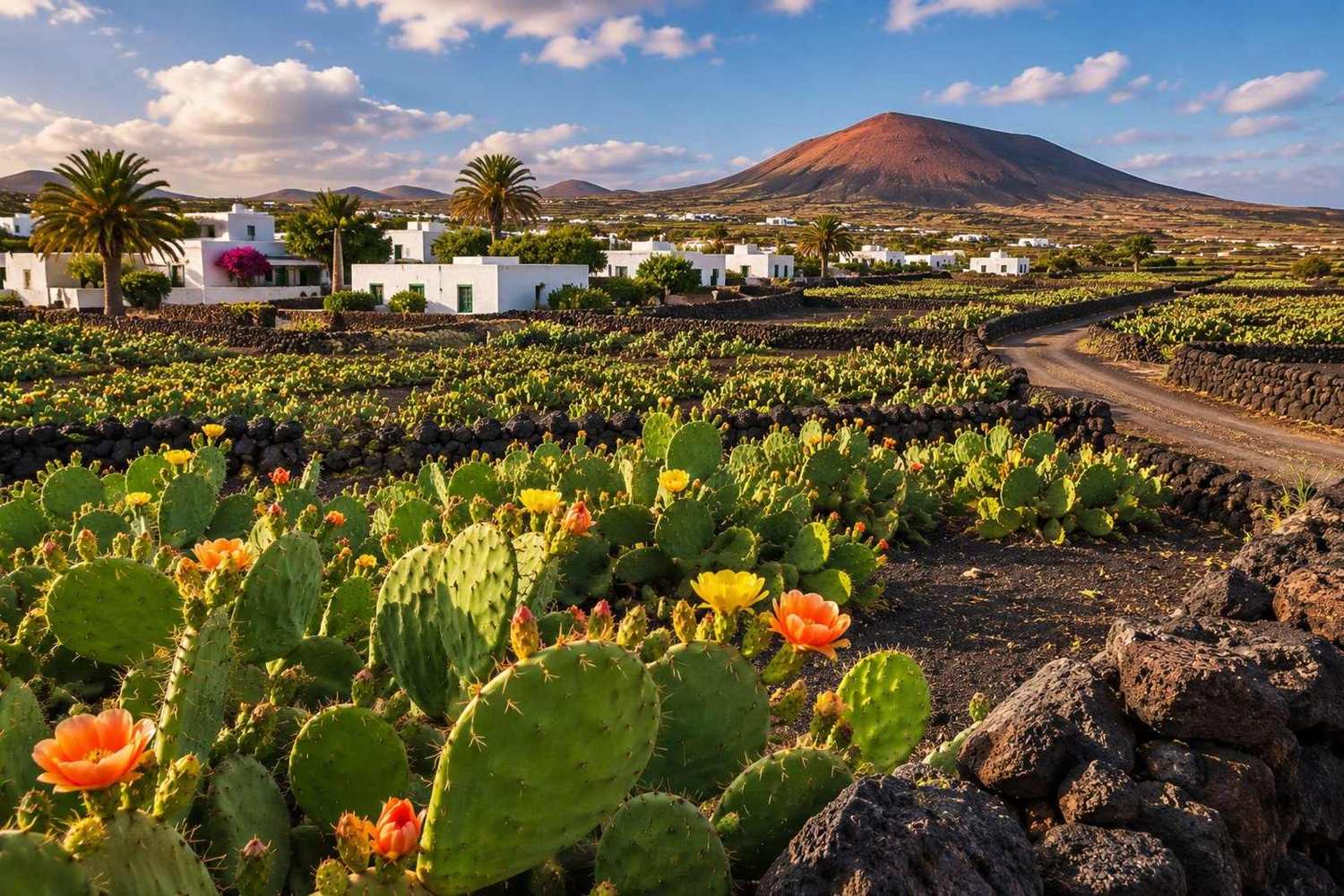
The garden makes much more sense when you look at what surrounds it. Every field around Guatiza and neighbouring Mala is planted with prickly pear, the flat-padded cactus the Spanish brought from the Americas centuries ago. Nobody grows it here for the fruit. The pads host cochineal, a tiny insect that produces one of the deepest red dyes in nature, and from the late nineteenth century this was serious business for Lanzarote: red gold, crushed, dried and exported by the barrel. Synthetic dyes killed most of the trade, but some production continues, and the landscape it left behind is unmistakable. Come in spring, when the pads flower in yellows and oranges and the whole valley looks painted.
Drive slowly through the village and you see the real Lanzarote: low white houses, gravel courtyards, goats, a bar that opens when it opens, and fields of green pads going on until the lava stops them. Guatiza is small enough to cross on foot in ten minutes, and the road north towards Haría threads through one of the greenest valleys on the island. This is the base I would choose for a slow exploration of the north, with the valley of a thousand palms, the caves and the sea all within a short drive. Ask me about tours and rentals in Haría and I will point you to the quiet roads in between.
Prickly pear and the red gold
Cochineal looks like white fluff on the pads until you know what you are seeing. The insects live under a protective waxy coat, and when they are crushed they give a crimson that once coloured the uniforms of armies and the robes of cardinals. Farmers here bred them on the pads for generations, and the technique is as old as the fields themselves: a little care, a lot of patience and a crop that never complains about the drought. A few families still work it. If you see a field with pads dusted white, you are looking at one of the island's oldest industries, still very much alive.
The quiet villages of Guatiza and Mala
Mala sits just up the road, even smaller, with a pretty church and the same slow rhythm. Together the two villages hold a handful of houses, a couple of places to eat and more silence than you will find anywhere on the south coast. Children still ride bikes down the middle of the street and nobody has ever hurried here. Bring cash for the small places, wave at everyone, and if a farmer invites you to look at the fields, say yes. This is where a day on the island turns from sightseeing into something you will actually remember.
Planning Your Day in the North-East
Guatiza sits on the LZ-1, the old road that runs north from Arrecife towards Haría, and it takes roughly twenty minutes from the capital or half an hour from Puerto del Carmen. Everything in the north-east hangs together like a necklace: the garden, the lava tube of Cueva de los Verdes, the underground lake at Jameos del Agua, the lookout at Mirador del Río and the fishing port of Órzola with the ferry to La Graciosa. Two of those in one day is a good day, three is a great one. I would take the garden first, in the morning light, and let the caves have the afternoon.
Public transport out here is thin, so you want your own wheels. One of my excursions in Lanzarote covers the whole north with someone else driving, or take a car and stop wherever the view asks you to. Roads are good and quiet, but the north is greener and narrower than the south: expect curves, cyclists and the odd goat with a death wish. Fill the tank in Arrecife, carry water, and keep the evening free for the drive back through the valley as the light turns gold. If you only have one free day on the island, spend it here rather than queuing somewhere else: the north-east gives you art, agriculture, caves and coastline without ever feeling rushed.
Getting there and combining it with the caves
From Puerto del Carmen, take the LZ-2 to Arrecife and then the LZ-1 north, signed for Haría; the garden is on your left just before Guatiza, marked by that enormous metal cactus. If you are on two wheels, the ride from the capital through the cactus fields is one of the gentlest on the island, and electric bike hire in Lanzarote makes the few climbs disappear. Combine the garden with Jameos del Agua and Cueva de los Verdes a short drive further north, then finish in Haría for coffee in the palm-shaded square before heading back.
Prices, hours and practical tips
The Jardín de Cactus opens every day of the year from ten in the morning until five in the afternoon, with the last entry at half past four. An adult ticket costs around nine euros and children under seven go free, which makes it the friendliest-priced of the island's great sites. Plan about an hour, more if you take photographs. The paths are volcanic stone, so wear proper shoes, take water and a hat in summer, and watch the little ones near the pond and the big spiny ones everywhere else. Free parking, toilets, café and shop on site.
You might also be interested in: Car hire in Lanzarote · The best excursions in Lanzarote · Electric bike hire in Lanzarote · Tours around Lanzarote · Rentals & excursions in Teguise · Tours & rentals in Haría · Lanzarote for families · Lanzarote for couples
Every adventure with Zack follows the same promise: no stress, no surprises, just the right experience at the right moment. Before you even arrive, he is already thinking about the wind, the light, the perfect hour and the little details that turn a holiday into a story you will tell for years. Guatiza and the Cactus Garden: The Green Jewel of Lanzarote is not just a booking: it is the beginning of your Lanzarote story.
How it works: from the first message to your best memory
1. Choose your adventure
Scroll through this page and feel what fits you: Guatiza and the Cactus Garden: The Green Jewel of Lanzarote, or maybe something different? Every traveller is unique, and Zack knows it. Look at the photos, read the tips, and if you are not sure, that is the best moment to write: telling him who you are and what you love is enough, and he will build the perfect day around it.
2. Book in one message
No forms, no call centres: one WhatsApp message and you are in. Zack replies with availability, the honest price and the plan for the day, including what to bring and when to start. The more days or people, the better the price — and if your plans change, you are talking to a real person who adapts.
3. Live the experience
This is where Lanzarote shows off. The island unfolds in colours you did not expect: black lava, red volcanoes, turquoise water and light that makes everything look like a film. With Guatiza and the Cactus Garden: The Green Jewel of Lanzarote you enjoy it your way, with a local team watching over every detail so that your only job is to have the time of your life.
4. Back home, happy
The tan fades, the memories do not. You go home with a phone full of photos, a heart full of stories and that feeling of having discovered a place rather than just visited it. Friends will ask for your itinerary: that is when you know you chose the right adventures.
5. Tell the world
If Zack and his team made your holiday special, the best thank you is a review on Google Maps: sixty seconds that help other travellers find the same magic, and make a local team very proud. Share your story, your photos and your tips — and become part of the Zack Lanzarote family.
Frequently asked questions
Where exactly is the Cactus Garden in Lanzarote?
The Jardín de Cactus is in Guatiza, a small village in the municipality of Teguise in the north-east of Lanzarote, on the LZ-1 road between Arrecife and Haría. It sits among the prickly pear fields, about twenty minutes by car from the capital and half an hour from Puerto del Carmen.
How long do you need at the Jardín de Cactus?
Most visitors spend about an hour walking the terraces, the pond and the windmill, and photographers usually stay longer. It is a compact garden you see from above and explore below, so there is no route to get wrong and no reason to rush.
How much is the ticket and do I need to book?
An adult ticket is around nine euros and children under seven enter free, which makes it the cheapest of the island's big CACT sites. You do not need to book or pick a time slot: just turn up between ten and five, last entry at half past four.
How do I plan a day around Guatiza with Zack?
Come and see me at Zack Bike Lanzarote, Calle Roque Nublo 10, Puerto del Carmen. Bikes start at 10 euros a day for kids, 15 for city and trekking bikes, 20 for mountain bikes and 30 for electric ones, less per extra day; cars and excursions are priced on request. Message me on WhatsApp +34 603 27 93 06 and we will build your day.
You may also like

Car hire in Lanzarote
Discover more →
The best excursions in Lanzarote
Discover more →
Electric bike hire in Lanzarote
Discover more →
Tours around Lanzarote
Discover more →Punta Mujeres: The Fishing Village of Natural Pools
Discover more →San Ginés Festival: Arrecife's Biggest Summer Party
Discover more →Lanzarote Food Guide: Eating Like a Local on a Volcanic Island
Discover more →Puerto del Rosario City Guide: The Real Capital of Fuerteventura
Discover more →Costa Teguise City Guide: Beaches, Wind and the Pueblo Marinero
Discover more →Playa Blanca City Guide: Lanzarote's Sunny Southern Harbour
Discover more →Yaiza and El Golfo: Lanzarote's Green Lagoon and Prettiest Village
Discover more →Puerto del Carmen Neighbourhoods: Centro, Los Pocillos and Matagorda
Discover more →Day Trip from Lanzarote to Corralejo, Fuerteventura
Discover more →Las Palmas de Gran Canaria and the Canary Islands Region
Discover more →Famara and Caleta de Famara: the Wild Side of Lanzarote
Discover more →Arrecife City Guide: the Capital of Lanzarote Beyond the Guidebooks
Discover more →Lanzarote in Autumn: Weather, Beaches and the Best Things to Do
Discover more →Teguise City Guide: the Old Capital and the Sunday Market
Discover more →La Graciosa: How to Visit the Eighth Canary Island
Discover more →Haría and the North of Lanzarote: Valleys, Cliffs and Palm Groves
Discover more →Tinajo and the Volcanic North of Lanzarote
Discover more →Lanzarote in Winter: Weather, Festivals and the Best Things to Do
Discover more →San Bartolomé City Guide: The Agricultural Heart of Lanzarote
Discover more →Lanzarote in Spring: Weather, Beaches and the Best Things to Do
Discover more →Órzola and the Far North: the Fishing Village at the End of the Road
Discover more →Lanzarote in Summer: Long Days, Warm Sea and the Island at Its Best
Discover more →Puerto Calero City Guide: The Marina and the Quiet Side of Lanzarote
Discover more →Maspalomas City Guide: The Dunes and the Sunny South of Gran Canaria
Discover more →Christmas and New Year in Lanzarote: Winter Sun, Fiestas and Local Traditions
Discover more →Betancuria and the Heart of Fuerteventura: the White Town in the Green Valley
Discover more →La Geria and the Volcanic Vineyards of Lanzarote
Discover more →Ironman Lanzarote 2027: the Race, the Route and Race Week
Discover more →Timanfaya National Park: How to Visit the Fire Mountains of Lanzarote
Discover more →The César Manrique Route: The Man Who Built Modern Lanzarote
Discover more →Hiking in Lanzarote: The Best Walks on a Volcanic Island
Discover more →Papagayo Beaches: The Wild Southern Coves of Lanzarote
Discover more →Sea Safety in Lanzarote: How to Read the Water Like a Local
Discover more →Lanzarote Markets: The Complete Weekly Market Guide
Discover more →Carnival in Lanzarote: The Wildest Week on the Island
Discover more →Easter in Lanzarote: Semana Santa and Spring on the Island
Discover more →Day Trip to Jandía and Morro Jable from Lanzarote
Discover more →Romería de los Dolores: Lanzarote's Biggest Pilgrimage
Discover more →El Cotillo and the Wild North-West Coast of Fuerteventura
Discover more →Stargazing in Lanzarote: Dark Skies Over the Volcanoes
Discover more →La Santa: the Surf Village on Lanzarote's Wild West Coast
Discover more →Playa Honda and Matagorda: The Quiet Coast Next to the Airport
Discover more →Fiestas del Carmen: Lanzarote Honours the Sea
Discover more →Tías and the Inland Villages of Southern Lanzarote
Discover more →Guatiza and the Cactus Garden: The Green Jewel of Lanzarote
Discover more →Isla de Lobos: Day Trip to the Secret Island near Lanzarote
Discover more →Guatiza and the Cactus Garden: The Green Jewel of Lanzarote: related services and areas of Lanzarote
🔗 Services in Lanzarote
📍 Areas and towns of Lanzarote

Meet Zack — your adventurous guide in Lanzarote
Founder · adventurer at heart
Elegant on the outside, adventurer at heart. Zack is the one who shows up with a big smile and the perfect plan for your day. Fun, easy-going and always ready for one more adventure, he knows every corner of Lanzarote — and he tailors every experience to your needs. Tell him who you are travelling with and what you love: he takes care of the rest, with the best advice and a joke ready to go.
Your adventure starts with a smile. — Zack
Come and visit us at the shop!
You'll find Zack Bike Lanzarote in Puerto del Carmen — pass by for a coffee, honest advice and the right plan for your days on the island.
🏠 Calle Roque Nublo 10, Puerto del Carmen, Lanzarote, Spain