
El Cotillo and the Wild North-West Coast of Fuerteventura
Most people who cross to Fuerteventura see the dunes and turn back. Keep driving west for half an hour and the island changes character completely: lava fields, a lighthouse, and then El Cotillo, a fishing village wedged between turquoise rock pools and a proper Atlantic swell. It is where I send friends when they ask for one quiet day with the best water in the Canaries. Here is how I would do it, from Lanzarote and back before dinner.
⚡ Quick summary before you plan your days in Lanzarote
- What to know firstMost people who cross to Fuerteventura see the dunes and turn back.
- Who it is forEl Cotillo sits on the north-west shoulder of Fuerteventura, where the trade winds hit first and the ocean has spent a million years carving black rock into pools, points and blowholes.
- Main optionsWhat El Cotillo Is: a Fishing Village with Two Faces · The Lagoons of Los Lagos and the Tostón Coast · Getting There from Lanzarote and Getting Around · Eating, Timing and How to Plan Your Day
- Duration, prices and detailsCan you swim at El Cotillo? Yes, in the lagoons of Los Lagos: shallow, sheltered and perfect for children. At Piedra Playa and along the open coast the currents are strong, so swim only where the flags allow it and never turn your back on…
- How to bookBook on WhatsApp · +34 603 27 93 06


📷 Gallery

🧭 Zack's 3-click Lanzarote experience planner
💬 Send my plan to Zack on WhatsApp
Because a tour should feel like travelling with a friend: Zack designs the route around your rhythm, your curiosity and your camera roll — and changes it whenever you wish.
What El Cotillo Is: a Fishing Village with Two Faces
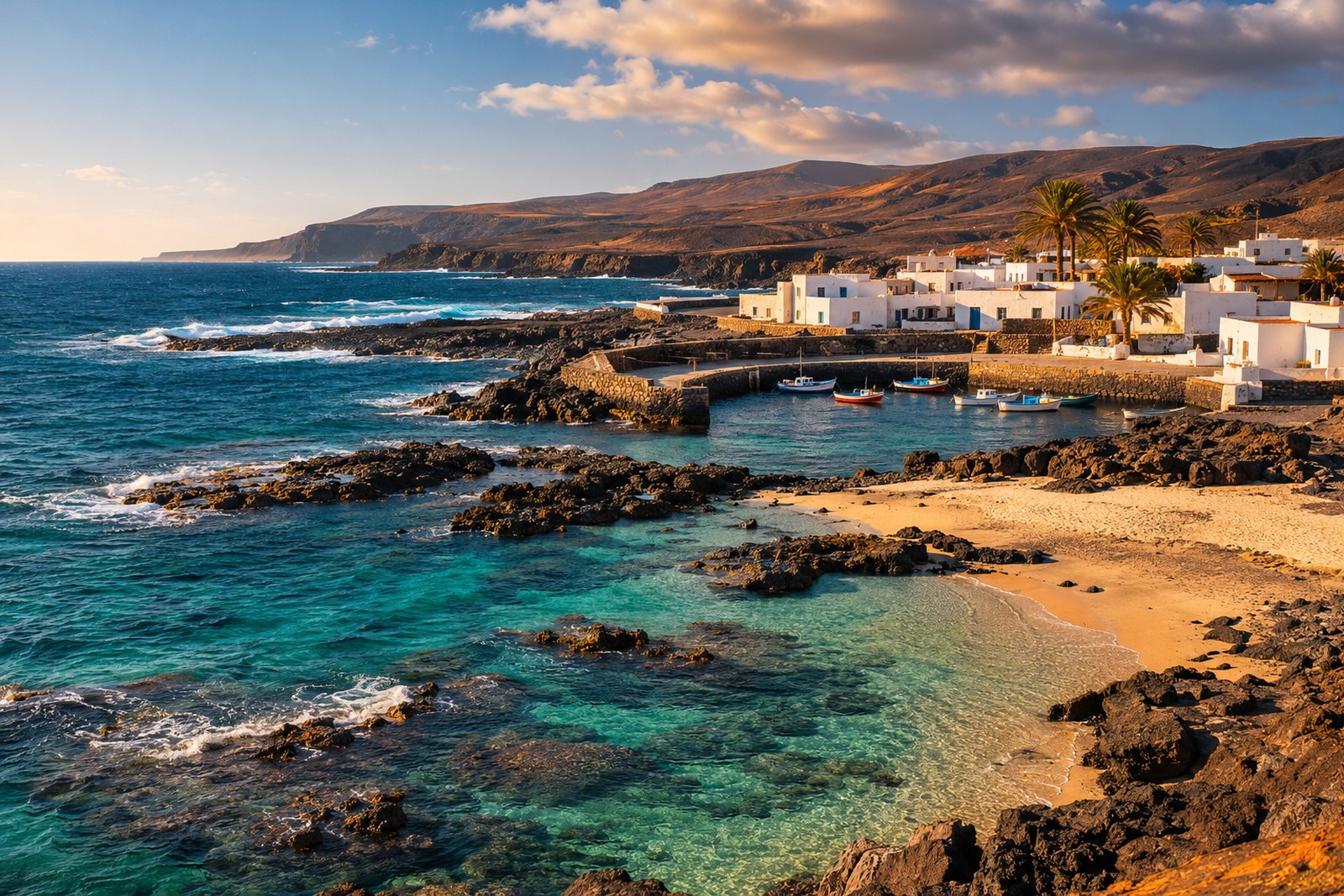
El Cotillo sits on the north-west shoulder of Fuerteventura, where the trade winds hit first and the ocean has spent a million years carving black rock into pools, points and blowholes. The village itself is tiny: a knot of white houses, a handful of fish restaurants, one small supermarket and two very different coastlines within a fifteen-minute walk of each other. That double nature is exactly why it works so well as a day trip from Lanzarote.
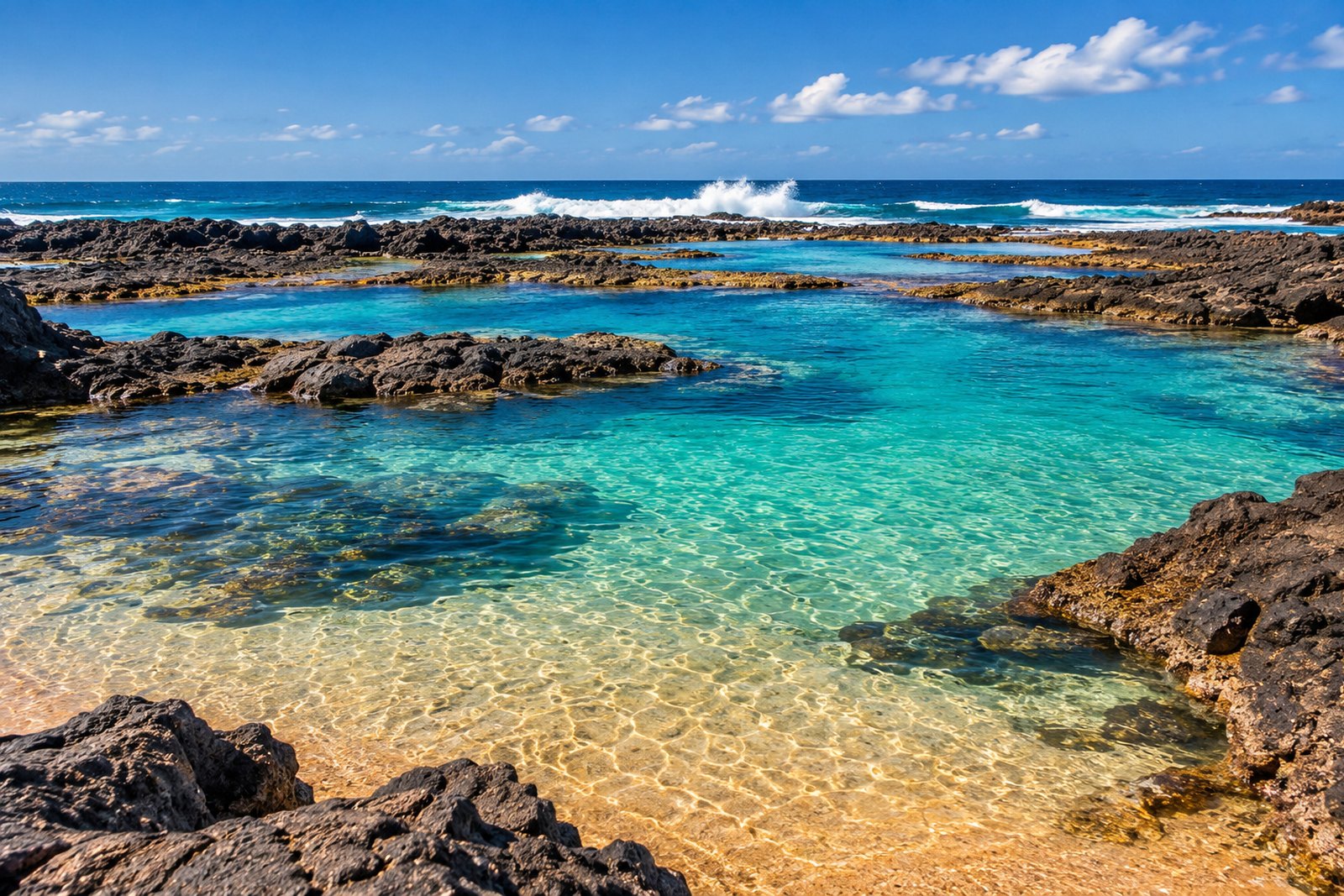
On one side you have the lagoons: shallow, sheltered pools of clear water held in place by volcanic rock, warm as a bath by midday and calm enough for small children. On the other, the open Atlantic rolls in unopposed and produces some of the best waves in the Canaries. Surfers and families share the same village, eat in the same restaurants and walk home under the same enormous sunset.
There is no rush here, and that is the whole point. Fishing boats still go out at dawn, old men still fix their nets in the harbour shade, and the only real traffic jam happens when the wind gets up in the afternoon and every surfer on the island appears on the beach road at once. If you want neon and nightclubs, stay in Corralejo. If you want a day that feels like a proper holiday, come here.
What I like about El Cotillo is that it never pretended to be a resort. There is no wall of apartment blocks along the sea, no banana-boat strip, no menu with photographs. Just a village, a lighthouse and some of the most transparent water I have ever seen from a car window. Bring a mask and snorkel and you will understand why I keep coming back on my days off.
The surf is not an add-on here, it is the other half of the story. Wetsuits dry on walls, boards stick out of small cars and the surf schools fill their classes with beginners from all over Europe. Nobody cares if you stand up on your first wave; the local rules are simple, respect the swimming beaches, respect the line-up and buy the first round afterwards. That mix of fishing village and surf village is what gives El Cotillo its character, and it is the reason the place still feels real.
The Old Harbour and the White Village
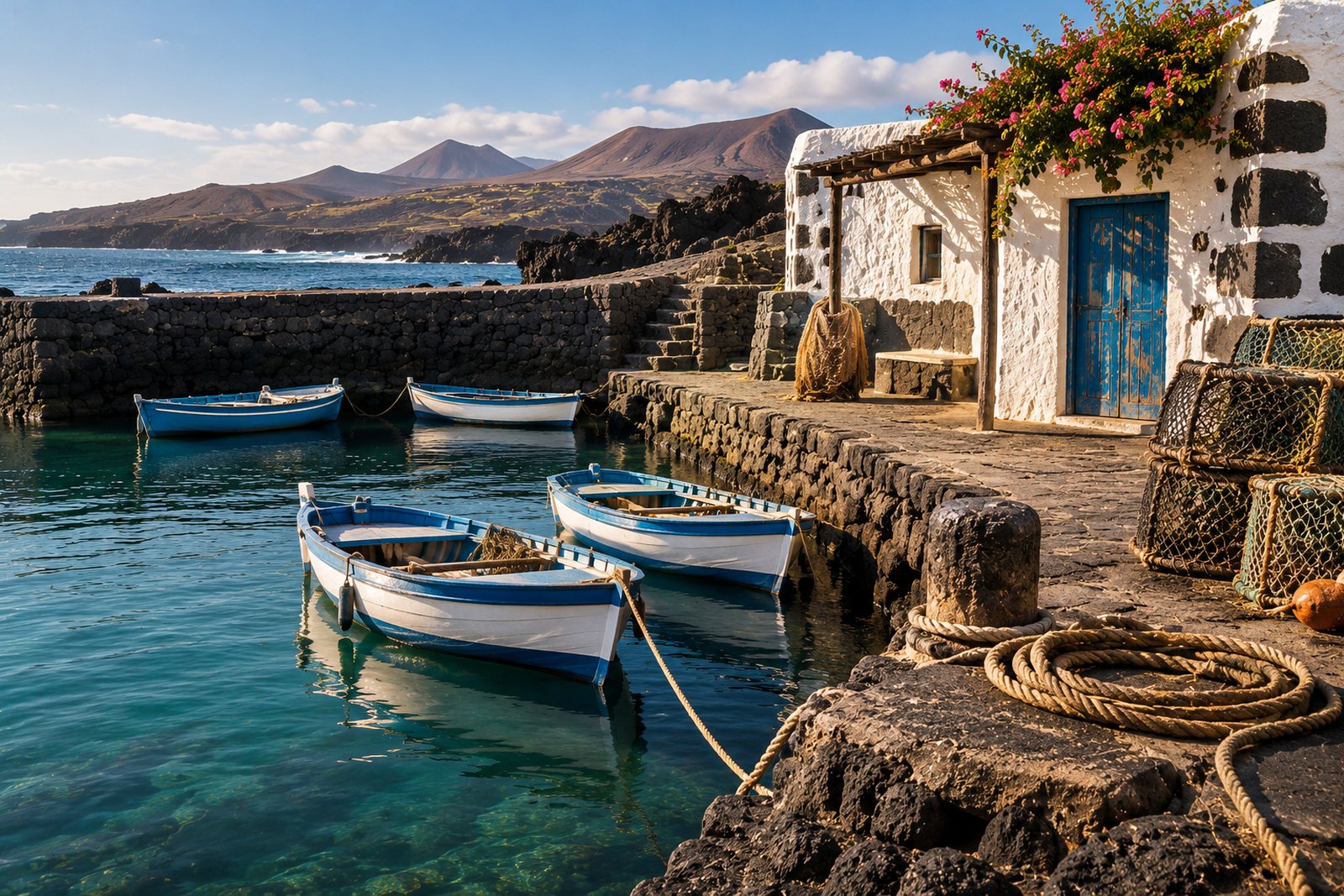
The old harbour is the postcard version of El Cotillo: a semicircle of dark stone walls holding back a pool of green water, three or four wooden boats painted blue and white, and a couple of old houses leaning over the quay. In the morning it smells of diesel and seaweed and the light turns everything silver. Walk the lanes behind it and you find bougainvillea over white walls, cats asleep on warm stone and the odd gallery selling the kind of ceramics you actually want to carry home.
Two Coasts in One Village: Lagoons and Surf
The trick to understanding El Cotillo is to know which side you are on. The southern side, towards the lagoons, is gentle: shallow water, sandy bottoms, easy swimming. The northern side, where the beach of Piedra Playa opens to the ocean, is the wild one: long Atlantic rollers, a heavy shore break and currents that do not negotiate. Surfers love it; swimmers should respect the flags. Between the two, the village sits quietly and lets you choose your mood for the day.
The Lagoons of Los Lagos and the Tostón Coast
Los Lagos are the reason most people come. They are natural pools formed by old lava flows, separated from the open ocean by a low black reef and floored with pale sand, so the water turns that impossible turquoise that looks Photoshopped and is not. On a calm morning you float in half a metre of warm water while the Atlantic breaks white over the rocks a few metres away.
They get busy in summer, because everyone eventually hears about them. The move is to arrive before eleven, claim a patch of sand and spend the morning in the water; by lunchtime the gravel car parks are full and the afternoon wind, the alisios, ruffles the surface and cools everything down. There is little natural shade, so bring an umbrella or a serious hat, and reef shoes make the rocky edges painless for the kids.
North of the lagoons the coast gets progressively wilder. Rough tracks and footpaths lead past black lava shelves, tiny coves and rock formations that make photographers go quiet. This is not swimming country; it is walking, watching and getting sprayed country. The wind is constant and honest, and on clear mornings you can see the island of Lobos and the coast of Lanzarote lying on the horizon like a low cloud.
Everything on this stretch points towards the Faro de Tostón, the lighthouse that marks the north-west corner of Fuerteventura. It is a working lighthouse with a small centre about traditional fishing, and beside it stands the Torre del Tostón, a squat defensive tower built centuries ago to warn the villages about pirates. Between the two you get one of the best sunset viewpoints on the island and barely a railing in sight.
Playa de los Lagos: the Caribbean Corner
Playa de los Lagos is the family beach at the lagoons: a crescent of golden sand tucked behind the rock pools, sheltered from the swell and sloping gently into the water. Children can play here for hours and parents can actually sit down. Get there in the morning, park in the gravel lot and walk the last stretch on foot; later the wind picks up and the sand starts flying, which is nature telling you it is time to go and eat fish.
Faro de Tostón and the Wild Shore
The lighthouse is fifteen minutes north of the village along a rough coastal track, and it is worth every bump. Around it the lava has been polished by the wind into shapes that look deliberate, and the ocean hits the reef with a noise you feel in your chest. Stay for sunset if you can: the light goes gold, then pink, then the lighthouse beam starts its slow sweep and the whole coast turns cinematic. Bring a jacket, because the wind does not care what month it is.
The Wind: When to Come and When to Wait
The wind here is the clock you set your day by. Mornings are usually calm and glassy, perfect for the lagoons; by early afternoon the alisios arrive and the water gets texture, which is when the surfers cheer and the swimmers pack up. In winter the pattern is the same but the light is softer and the whole coast is emptier. Check the forecast the night before: on the rare days the wind turns south-west, the lagoons go cloudy and the north coast turns spectacular.
Getting There from Lanzarote and Getting Around
The simplest way to reach El Cotillo from Lanzarote is to take the car across on the ferry. Boats run between Playa Blanca and Corralejo several times a day, the crossing takes about half an hour, and you drive off on the other side with your own wheels. Book the crossing a couple of days ahead in high season, turn up at the port forty minutes early with your documents ready, and the whole thing is painless.
From Corralejo it is a straight run west on the FV-1 and then the FV-10, roughly thirty minutes through a landscape from another planet: lava fields, the volcano of Calderón Hondo on the left, the sacred mountain of Tindaya ahead and the small white villages of La Oliva and Lajares along the way. It is one of those drives where nobody in the back seat asks how much longer.
No car? That is exactly what my excursions in Lanzarote are for: I build the route around the day you want and get you back in time for dinner. If you do drive yourself, park near the harbour or by the lagoons in the morning and forget the car until evening: the village is small, and walking between the harbour and Los Lagos takes a relaxed twenty minutes along the coast.
The other option is to make El Cotillo the anchor of a bigger day. The Corralejo dunes sit on the road back to the ferry, Betancuria is forty minutes inland and the northern coast towards Majanicho is empty and strange in the best possible way. With car hire in Lanzarote sorted before you leave, the plan stays flexible: you decide at lunch whether the afternoon belongs to the lagoons or to the mountains.
The Ferry to Corralejo and the Drive North
Two companies sail the Playa Blanca to Corralejo route, fast ferries and slower ones, and as a foot passenger you can be standing in the water at Los Lagos ninety minutes after leaving your hotel. Bringing the car gives you freedom, though, and out here freedom is the whole game. Check the return times before you go exploring: the last boats leave Corralejo in the early evening, and nobody wants to sleep in the port car park.
Eating, Timing and How to Plan Your Day
El Cotillo eats fish. The restaurants around the harbour and along the seafront grill whatever the boats brought in: viejas, cherne, octopus, calamari, always with wrinkled potatoes and the two mojo sauces, red and green. Order the catch of the day, ask what came in this morning, and finish with a local goat cheese and a glass of something cold. In summer book a table for sunset or come early, because the good terraces fill up fast.
A day here has a natural shape. Morning: the lagoons, while the water is flat and the sand is still cool. Midday: a long lunch in the shade. Afternoon: the lighthouse walk, a surf session or a siesta, depending on your religion. Evening: the west coast does its sunset show and the village slowly turns on its lights. Back on the ferry you will be tired in the best possible way.
Practical things. Take sunscreen and water, because the sun on this coast is stronger than it looks and the little shops close at siesta time. Cash is useful in the small places. A light jacket stays in my bag all year round, because when the wind turns north it gets fresh fast. And if the swell is big, admire the sea from the rocks and do your swimming in the lagoons instead.
And if the wind wins? It happens. In that case I turn the day around: lagoons early anyway, then inland towards La Oliva and the volcano country around Tindaya, where the wind means nothing and the views go on forever. Or I take the slow option, find a terrace out of the wind, order another coffee and accept that on this coast the weather is the boss. El Cotillo rewards patience: give it two hours and the light alone will pay you back.
If you want help putting the day together, write me on WhatsApp at +34 603 27 93 06 or come and find me at Zack Bike Lanzarote, Calle Roque Nublo 10, in Puerto del Carmen. I rent bikes every day: kids bikes at 10 euros, city and trekking at 15, mountain bikes at 20 and electrics at 30, and the price drops the longer you keep one. Cars and tours I arrange on request, and my boat trips in Lanzarote pair perfectly with a day on this coast.
Fresh Fish at the Harbour Tables
Eating is one of the main reasons to come to El Cotillo, so do not rush it. The kitchens here are simple and the product does the work: a grilled fish, a plate of limpets if they have them, potatoes with mojo and a salad that tastes of sun. Sit outside, watch the boats and let two hours disappear. Then order coffee and a local dessert and let the afternoon wind do the sightseeing for you.
You might also be interested in: Car hire in Lanzarote · The best excursions in Lanzarote · Boat hire & boat trips in Lanzarote · Catamaran trips in Lanzarote · Boat trips & rentals in Playa Blanca · La Graciosa trips & rentals in Órzola · Rentals & excursions in Puerto del Carmen · Lanzarote for families · Lanzarote for couples
Every adventure with Zack follows the same promise: no stress, no surprises, just the right experience at the right moment. Before you even arrive, he is already thinking about the wind, the light, the perfect hour and the little details that turn a holiday into a story you will tell for years. El Cotillo and the Wild North-West Coast of Fuerteventura is not just a booking: it is the beginning of your Lanzarote story.
How it works: from the first message to your best memory
1. Choose your adventure
Scroll through this page and feel what fits you: El Cotillo and the Wild North-West Coast of Fuerteventura, or maybe something different? Every traveller is unique, and Zack knows it. Look at the photos, read the tips, and if you are not sure, that is the best moment to write: telling him who you are and what you love is enough, and he will build the perfect day around it.
2. Book in one message
No forms, no call centres: one WhatsApp message and you are in. Zack replies with availability, the honest price and the plan for the day, including what to bring and when to start. The more days or people, the better the price — and if your plans change, you are talking to a real person who adapts.
3. Live the experience
This is where Lanzarote shows off. The island unfolds in colours you did not expect: black lava, red volcanoes, turquoise water and light that makes everything look like a film. With El Cotillo and the Wild North-West Coast of Fuerteventura you enjoy it your way, with a local team watching over every detail so that your only job is to have the time of your life.
4. Back home, happy
The tan fades, the memories do not. You go home with a phone full of photos, a heart full of stories and that feeling of having discovered a place rather than just visited it. Friends will ask for your itinerary: that is when you know you chose the right adventures.
5. Tell the world
If Zack and his team made your holiday special, the best thank you is a review on Google Maps: sixty seconds that help other travellers find the same magic, and make a local team very proud. Share your story, your photos and your tips — and become part of the Zack Lanzarote family.
Frequently asked questions
Can you swim at El Cotillo?
Yes, in the lagoons of Los Lagos: shallow, sheltered and perfect for children. At Piedra Playa and along the open coast the currents are strong, so swim only where the flags allow it and never turn your back on the Atlantic.
How do I get to El Cotillo from Lanzarote?
Take the ferry from Playa Blanca to Corralejo, about half an hour, then drive west for thirty minutes. You can take a hire car on the boat or join one of my excursions and let someone else do the driving.
When is the best time to visit?
Morning, all year round: the lagoons are calmest before the trade winds get up. In summer arrive early for parking; in winter come for the surf, the empty coast and sunsets that are at their best between October and March.
How do I book bikes, cars or tours?
Write me on WhatsApp at +34 603 27 93 06 or pass by Zack Bike Lanzarote, Calle Roque Nublo 10 in Puerto del Carmen. Kids bikes 10 euros a day, city and trekking 15, mountain 20 and electric 30, and the price drops the longer you keep one. Cars, tours and the rest on request.
You may also like

Car hire in Lanzarote
Discover more →
The best excursions in Lanzarote
Discover more →
Boat hire & boat trips in Lanzarote
Discover more →
Catamaran trips in Lanzarote
Discover more →Punta Mujeres: The Fishing Village of Natural Pools
Discover more →San Ginés Festival: Arrecife's Biggest Summer Party
Discover more →Lanzarote Food Guide: Eating Like a Local on a Volcanic Island
Discover more →Puerto del Rosario City Guide: The Real Capital of Fuerteventura
Discover more →Costa Teguise City Guide: Beaches, Wind and the Pueblo Marinero
Discover more →Playa Blanca City Guide: Lanzarote's Sunny Southern Harbour
Discover more →Yaiza and El Golfo: Lanzarote's Green Lagoon and Prettiest Village
Discover more →Puerto del Carmen Neighbourhoods: Centro, Los Pocillos and Matagorda
Discover more →Day Trip from Lanzarote to Corralejo, Fuerteventura
Discover more →Las Palmas de Gran Canaria and the Canary Islands Region
Discover more →Famara and Caleta de Famara: the Wild Side of Lanzarote
Discover more →Arrecife City Guide: the Capital of Lanzarote Beyond the Guidebooks
Discover more →Lanzarote in Autumn: Weather, Beaches and the Best Things to Do
Discover more →Teguise City Guide: the Old Capital and the Sunday Market
Discover more →La Graciosa: How to Visit the Eighth Canary Island
Discover more →Haría and the North of Lanzarote: Valleys, Cliffs and Palm Groves
Discover more →Tinajo and the Volcanic North of Lanzarote
Discover more →Lanzarote in Winter: Weather, Festivals and the Best Things to Do
Discover more →San Bartolomé City Guide: The Agricultural Heart of Lanzarote
Discover more →Lanzarote in Spring: Weather, Beaches and the Best Things to Do
Discover more →Órzola and the Far North: the Fishing Village at the End of the Road
Discover more →Lanzarote in Summer: Long Days, Warm Sea and the Island at Its Best
Discover more →Puerto Calero City Guide: The Marina and the Quiet Side of Lanzarote
Discover more →Maspalomas City Guide: The Dunes and the Sunny South of Gran Canaria
Discover more →Christmas and New Year in Lanzarote: Winter Sun, Fiestas and Local Traditions
Discover more →Betancuria and the Heart of Fuerteventura: the White Town in the Green Valley
Discover more →La Geria and the Volcanic Vineyards of Lanzarote
Discover more →Ironman Lanzarote 2027: the Race, the Route and Race Week
Discover more →Timanfaya National Park: How to Visit the Fire Mountains of Lanzarote
Discover more →The César Manrique Route: The Man Who Built Modern Lanzarote
Discover more →Hiking in Lanzarote: The Best Walks on a Volcanic Island
Discover more →Papagayo Beaches: The Wild Southern Coves of Lanzarote
Discover more →Sea Safety in Lanzarote: How to Read the Water Like a Local
Discover more →Lanzarote Markets: The Complete Weekly Market Guide
Discover more →Carnival in Lanzarote: The Wildest Week on the Island
Discover more →Easter in Lanzarote: Semana Santa and Spring on the Island
Discover more →Day Trip to Jandía and Morro Jable from Lanzarote
Discover more →Romería de los Dolores: Lanzarote's Biggest Pilgrimage
Discover more →El Cotillo and the Wild North-West Coast of Fuerteventura
Discover more →Stargazing in Lanzarote: Dark Skies Over the Volcanoes
Discover more →La Santa: the Surf Village on Lanzarote's Wild West Coast
Discover more →Playa Honda and Matagorda: The Quiet Coast Next to the Airport
Discover more →Fiestas del Carmen: Lanzarote Honours the Sea
Discover more →Tías and the Inland Villages of Southern Lanzarote
Discover more →Guatiza and the Cactus Garden: The Green Jewel of Lanzarote
Discover more →Isla de Lobos: Day Trip to the Secret Island near Lanzarote
Discover more →El Cotillo and the Wild North-West Coast of Fuerteventura: related services and areas of Lanzarote

Meet Zack — your adventurous guide in Lanzarote
Founder · adventurer at heart
Elegant on the outside, adventurer at heart. Zack is the one who shows up with a big smile and the perfect plan for your day. Fun, easy-going and always ready for one more adventure, he knows every corner of Lanzarote — and he tailors every experience to your needs. Tell him who you are travelling with and what you love: he takes care of the rest, with the best advice and a joke ready to go.
Your adventure starts with a smile. — Zack
Come and visit us at the shop!
You'll find Zack Bike Lanzarote in Puerto del Carmen — pass by for a coffee, honest advice and the right plan for your days on the island.
🏠 Calle Roque Nublo 10, Puerto del Carmen, Lanzarote, Spain